

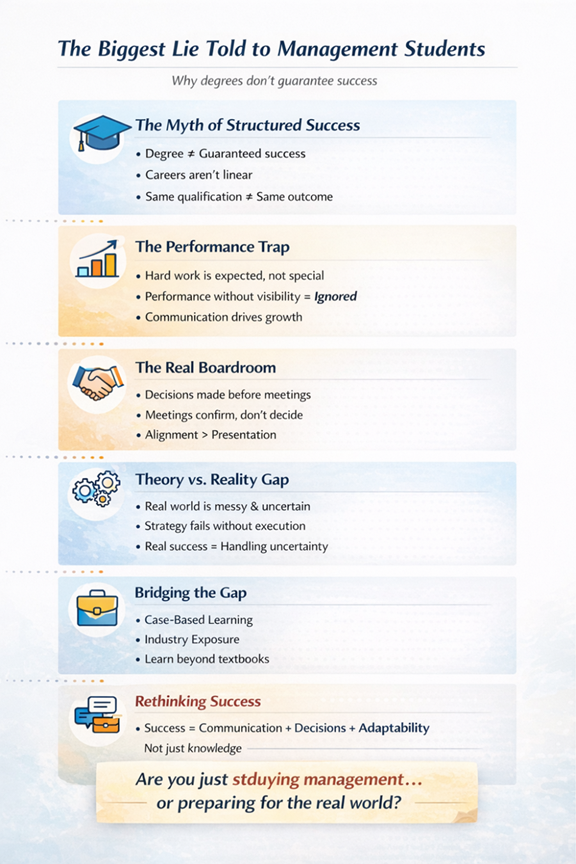
The Myth of “Structured Success”
For years, management students have been sold a comforting narrative: Get into a good college → earn your degree → secure a placement → success will follow.
It sounds logical. Structured. Safe.
But the real world doesn’t operate on such predictable lines.
A degree may open the first door—but it does not determine how far you go. Step into the corporate world, and you quickly realize that growth is rarely linear. Two individuals with similar qualifications often end up on entirely different trajectories.
Why?
Because success depends on far more than credentials.
The Performance Trap: Why Hard Work Isn’t Enough
One of the biggest surprises for fresh graduates is this:
Hard work is expected. It’s not a differentiator.
Consider two employees delivering similar results. One quietly submits their work. The other communicates outcomes clearly, highlights impact, and aligns their contributions with team and business goals.
Who gets noticed?
More often than not, it’s the one who knows how to position their work.
This doesn’t diminish the importance of performance—but it highlights a critical reality: Without visibility, performance often goes unrecognized.
The Real Boardroom: Where Decisions Actually Happen
Many students believe decisions are made in formal meetings.
In reality, meetings are often just confirmations.
Before any major proposal is approved, conversations typically happen informally—over quick calls, one-on-one discussions, or internal alignments. By the time the meeting begins, consensus has often already been built.
Understanding this changes everything.
It shifts your focus from merely presenting ideas to building alignment, relationships, and influence ahead of time.
The Credential Gap: Theory vs. Reality
Management education builds a strong theoretical foundation—but the corporate environment is far more complex.
Textbooks offer structured solutions. Reality presents ambiguity, competing interests, and time constraints.
A strategy that looks perfect on paper can fail due to misaligned stakeholders or poor execution timing.
This is why many academically strong students initially struggle—they are trained to find answers, not to navigate uncertainty.
Today, organizations value professionals who can:
- Adapt quickly
- Communicate effectively
- Make decisions despite incomplete information
Bridging the Gap: A More Practical Approach
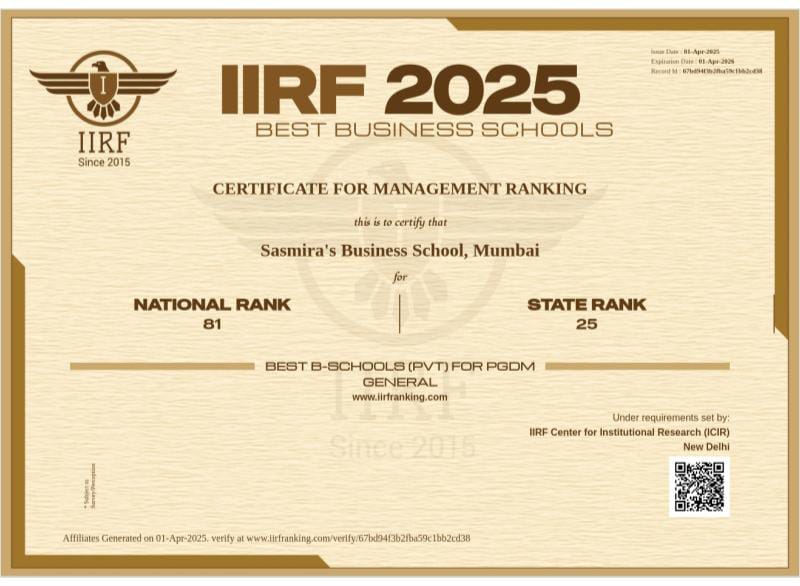
This is where institutions like Sasmira’s Business School, Worli are rethinking management education.
By moving beyond purely theoretical learning, the focus shifts to:
- Case-based learning
- Industry interactions
- Real-world business exposure
Located in Mumbai’s corporate hub, students gain proximity to the industry ecosystem—helping them understand how businesses actually function.
The goal is not just to earn a degree, but to build the ability to think critically, adapt quickly, and contribute meaningfully from day one.
Conclusion: Rethinking Success
Success in management isn’t defined by intelligence or academic performance alone.
It is shaped by your ability to:
- Understand people
- Communicate ideas
- Create value in real-world situations
Because ultimately—
Your career isn’t built in classrooms. It’s built in how you apply what you’ve learned.
So here’s the real question:
Are you just studying management… or are you preparing for the realities of the corporate world?