

For years, students across India have been told one thing:
“If you want a successful corporate career, just do an MBA.”
But the business world has changed. Industries are evolving faster than textbooks. Recruiters are looking beyond degrees. Companies want professionals who can think strategically, solve real business problems, adapt to technology, and lead with confidence.
And this is where one of the biggest misconceptions begins:
“PGDM is less valuable than an MBA.”
That belief is outdated.
At Sasmira Business School, we regularly interact with students who initially misunderstand what a PGDM actually offers. The reality is that a modern PGDM, when designed correctly, can be far more industry-relevant, practical, and career-focused than many traditional management programs.
Let’s break some of the biggest PGDM misconceptions students still believe — and uncover the truth behind them.
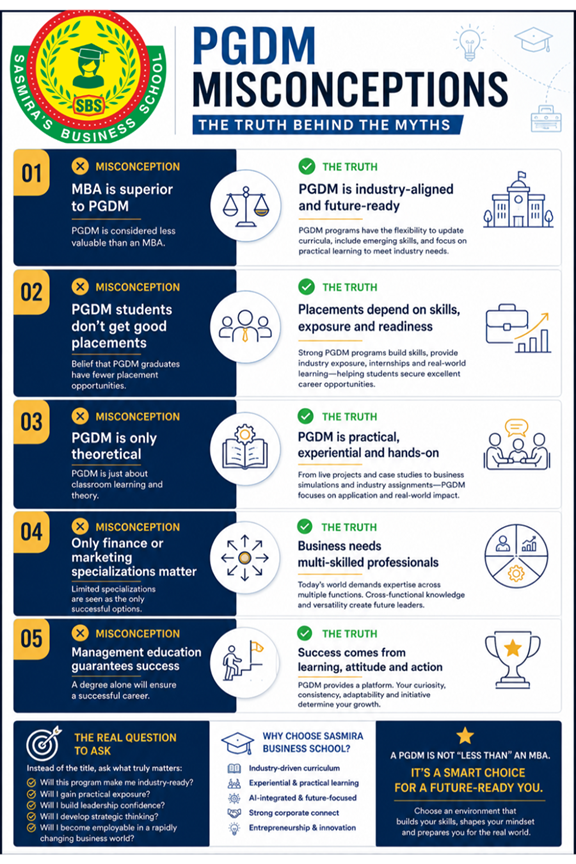
Misconception 1: “MBA is superior to PGDM”
This is probably the most common myth.
An MBA is typically affiliated with a university and follows a more fixed academic structure. A PGDM (Post Graduate Diploma in Management), especially from an AICTE-approved autonomous institution, has the flexibility to update its curriculum according to changing industry needs.
That means:
- Faster curriculum upgrades
- Better alignment with corporate expectations
- Inclusion of emerging skills like AI, analytics, entrepreneurship, digital business, and strategic thinking
- More practical learning methodologies
At Sasmira Business School, the PGDM curriculum is designed to bridge the gap between classroom learning and industry application.
The focus is not just on “studying management” — but on becoming industry-ready.
Misconception 2: “PGDM students don’t get good placements”
Placement outcomes depend less on the title of the program and more on:
- Skill development
- Industry exposure
- Internship quality
- Communication abilities
- Business understanding
- Institutional ecosystem
Today’s recruiters hire capable professionals — not just degree holders.
Organizations are actively looking for candidates who can:
- Analyze business situations
- Work with teams
- Handle ambiguity
- Communicate effectively
- Understand technology-driven business environments
A strong PGDM program builds these capabilities through:
- Live projects
- Case studies
- Industry interactions
- Simulation-based learning
- Corporate mentoring
- Internship exposure
At Sasmira Business School, students are trained not only for interviews but for long-term career growth.
Misconception 3: “PGDM is only theoretical”
A well-designed PGDM is actually built around application-based learning.
The modern business environment demands:
- Problem-solving
- Strategic thinking
- Decision-making under pressure
- Innovation
- Leadership adaptability
Traditional rote learning no longer works.
That’s why institutions like Sasmira Business School emphasize:
- Business simulations
- Real-world marketing activities
- Industry projects
- Entrepreneurial exposure
- Practical workshops
- AI-integrated learning approaches
The objective is simple: Students should be able to apply concepts in real business scenarios — not just write answers in exams.
Misconception 4: “Only finance or marketing specializations matter”
The business ecosystem today is multidimensional.
Companies increasingly need professionals who understand:
- Operations
- Human Resources
- Business Analytics
- Entrepreneurship
- Digital Transformation
- Supply Chain Management
- Strategic Management
Even more importantly, organizations now prefer professionals with cross-functional understanding.
This is why dual specialization and interdisciplinary learning are becoming highly valuable.
At Sasmira Business School, students are encouraged to build both domain expertise and business versatility.
Because future leaders are not limited by departments.
Misconception 5: “Management education guarantees success”
A management degree is not a shortcut to success.
It is a platform.
Your growth still depends on:
- Curiosity
- Consistency
- Networking
- Communication
- Learning attitude
- Adaptability
- Initiative
The best business schools do not simply provide placements.
They shape mindset.
A strong PGDM journey transforms students into:
- Thinkers
- Problem-solvers
- Collaborators
- Innovators
- Future leaders
And that transformation happens only when students actively participate in the learning ecosystem.
The Real Question Students Should Ask
Instead of asking:
“Is PGDM better than MBA?”
Students should ask:
- Will this program make me industry-ready?
- Will I gain practical exposure?
- Will I build leadership confidence?
- Will I develop strategic thinking?
- Will I become employable in a rapidly changing business world?
Because in today’s economy, employability matters more than labels.
Why the Future Belongs to Skill-Oriented Management Education
The next decade will belong to professionals who can:
- Combine business with technology
- Think strategically
- Learn continuously
- Adapt quickly
- Solve complex problems creatively
Management education is no longer about memorizing theories.
It is about building business capability.
At Sasmira Business School, the focus is on preparing students for the realities of modern business through:
- Industry-driven learning
- Experiential education
- Strategic thinking frameworks
- AI-integrated approaches
- Corporate exposure
- Entrepreneurship orientation
Because the future demands more than a degree.
It demands readiness.
Final Thought
A PGDM is not “less than” an MBA.
The value of any management program depends on how effectively it prepares students for the real world.
In an era where industries are changing rapidly, the right learning environment matters far more than outdated perceptions.
The question is no longer: “Which title sounds better?”
The real question is: “Which institution helps you become future-ready?”
And that is where the true difference begins.